
C-Skip

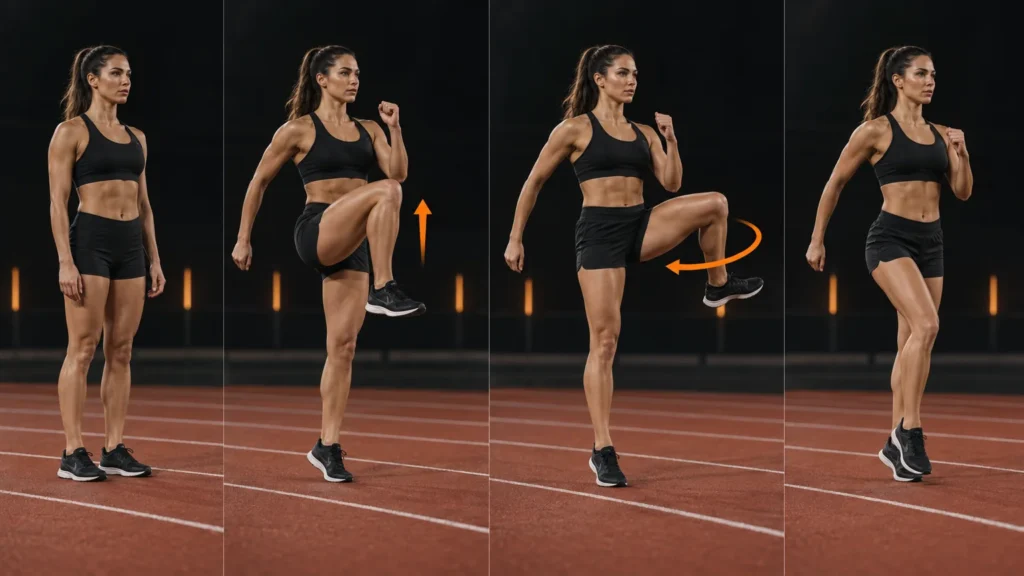
A dynamic track and field drill that combines vertical knee drive with hip abduction and rotation to improve sprint rhythm, hip mobility, and ankle stiffness.

Instructions
Exercise Technique
Common Mistakes
Variations
About This Exercise
The C-Skip is a staple warm-up and technical drill in sprint and hurdle disciplines. Evolving from the foundational A-Skip and B-Skip series, the C-Skip introduces multi-planar hip mobility by integrating sagittal hip flexion with hip abduction and external rotation. This movement actively reinforces pelvic stability, neuromuscular coordination, and lower-leg elastic recoil, making it invaluable for athletes across multidirectional and linear sports.
Tips
Stay tall through the torso, drive the knee up before opening wide, keep toes pulled up, and strike the ground directly below the hip.
Notes & Safety
Perform only on an even, resilient surface. Ensure thorough general warm-up before attempting explosive skips. Athletes with acute hip impingement or groin strains should modify the range of motion.
Deep Dive & Exercise Guide
Introduction
The C-Skip is an advanced sprint drill that builds upon foundational running mechanics. While drills like the A-Skip focus strictly on the sagittal plane, the C-Skip integrates lateral hip abduction and rotation into a rhythmic skipping action. This multi-planar drill enhances hip joint health, neuromuscular coordination, and lower-leg elastic reactivity, making it an essential movement for sprinters, hurdlers, and field athletes alike.
Benefits & Muscles Involved
The C-Skip targets critical muscles responsible for running locomotion and hip stabilization. The primary drivers include the hip flexors (iliopsoas and rectus femoris), the glutes (gluteus medius and gluteus maximus), and the calf complex (gastrocnemius and soleus). Secondary contributors include the adductors, hamstrings, quadriceps, tibialis anterior, and deep core stabilizers.
- Hip Mobility and Health: Actively explores full hip flexion, abduction, and rotation under dynamic control.
- Neuromuscular Coordination: Challenges the brain and motor units to coordinate reciprocal limb movement at high speeds.
- Ankle Stiffness and Elasticity: Trains the Achilles tendon and calf complex to absorb and return ground reaction forces rapidly.
- Sprint Posture Reinforcement: Demands an upright trunk and stable pelvis while moving limbs through complex planes.
How It Fits Into Training
The C-Skip functions best during dynamic warm-ups, technical speed preparation, or movement skill blocks. Positioned right after general mobility exercises and basic skips, it primes the nervous system and hip musculature for high-intensity running, sprinting, jumping, or change of direction drills.
Who Should Use It
Track and field athletes, especially sprinters and hurdlers, will find the C-Skip directly applicable to hip clearing and posture maintenance. Field and court athletes—such as soccer, basketball, and rugby players—benefit from the drill’s emphasis on multi-directional hip mobility and reactive foot strikes. Intermediate recreational runners seeking improved running economy can also benefit from incorporating it into their pre-run routine.
Programming Considerations
Because the C-Skip demands precise coordination and elastic stiffness, perform it in a non-fatigued state. Prescribe 2 to 4 sets over distances of 15 to 30 meters. Focus on crisp cadence, upright posture, and fluid hip movement rather than covering distance quickly. Rest for 30 to 60 seconds between sets to ensure movement quality remains high.
Tips for Better Performance
Keep your head up and eyes looking forward to prevent rounding the thoracic spine. Maintain tall posture by keeping your support hip fully extended when the opposite leg rises. Ensure your foot stays dorsiflexed throughout the motion, and actively pull the foot down to strike the surface directly under your center of mass with a lively, spring-like rebound.
FAQs
What is the difference between an A-Skip, B-Skip, and C-Skip?
An A-Skip focuses on knee lift and ground strike in the sagittal plane. A B-Skip extends the lower leg forward before striking downward. The C-Skip drives the knee up and opens it laterally to the outside, adding hip abduction and rotation to the skip.
Can beginners perform the C-Skip?
Beginners should master the marching C-walk and standard A-Skip before progressing to dynamic, fast C-Skips to ensure proper pelvic control and rhythm.
Related Exercises: Hill Power March · Tuck Jumps · Broad Jump · Depth Jump · Single-Leg Box Jump
Conclusion
The C-Skip is a versatile, high-reward movement that develops rotational hip capacity, posture, and elasticity. By programming it into regular warm-ups, athletes can enhance movement efficiency, sharpen technical execution, and reduce injury risk across demanding sports.