
Tuck Jumps

A high-intensity plyometric exercise designed to develop vertical power, hip flexor speed, and reactive strength through rapid lower-body triple extension and mid-air knee tucking.

Instructions
Exercise Technique
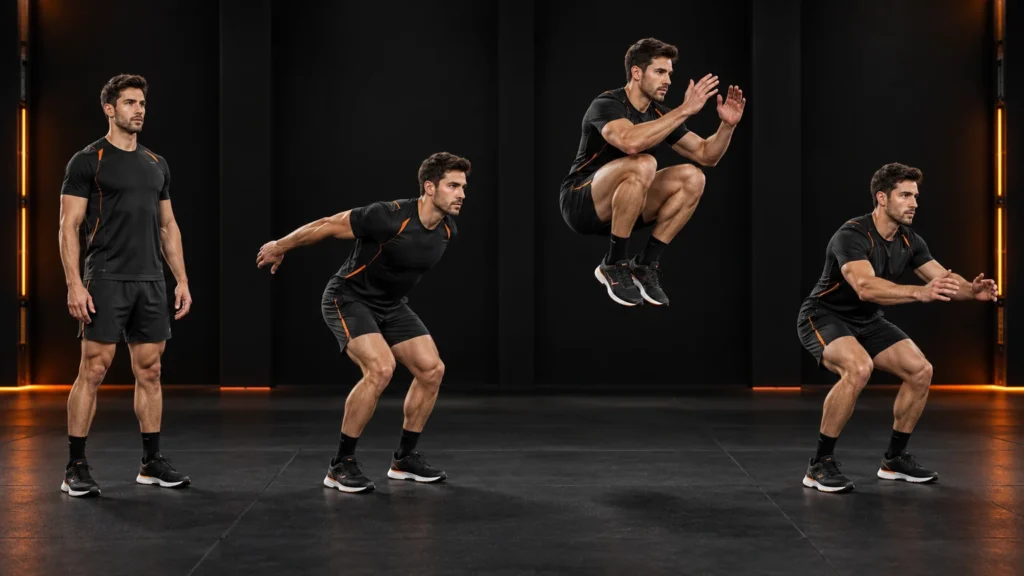
How To Perform
Common Mistakes
Variations
About This Exercise
Tuck jumps are an advanced, bodyweight plyometric drill that challenges lower-body power output, rapid core contraction, and reactive ground contact mechanics. Unlike standard vertical jumps, tuck jumps require athletes to exert maximum force to achieve sufficient hang time to pull both knees tightly toward the chest. This requires coordinated activation of the hip flexors and abdominal wall while preserving balance for a safe, controlled landing.
Because the movement demands rapid stretch-shortening cycle action and elevated neuromuscular output, it serves as an exceptional tool for sprinters, jumpers, and court-sport athletes seeking enhanced vertical jump performance and kinesthetic awareness.
Tips
Notes & Safety
Tuck jumps place significant shock forces on the ankles, patellar tendons, and knees. Athletes should demonstrate adequate baseline strength and sound landing mechanics before incorporating high-volume or continuous sets. Discontinue immediately if experiencing sharp joint discomfort.
Deep Dive & Exercise Guide
Introduction
Tuck jumps are one of the most effective bodyweight plyometric movements for building explosive vertical power, dynamic hip flexion speed, and full-body athletic control. By requiring athletes to jump as high as possible while drawing their knees directly to the chest in mid-air, tuck jumps demand both powerful ground-force production and rapid abdominal contraction. This makes them a staple drill across track and field, team sports, and athletic strength regimens.
Benefits & Muscles Involved
The primary drivers during the takeoff phase are the quadriceps, glutes, and calves, which fire simultaneously to achieve rapid triple extension. Once airborne, the hip flexors and rectus abdominis contract aggressively to bring the knees up toward the torso. The hamstrings provide knee flexion and assist in controlling deceleration upon landing.
Key benefits include:
- Greater rate of force development and vertical jump height.
- Enhanced reactive strength and shorter ground contact times.
- Increased hip flexor speed, which directly transfers to sprinting mechanics.
- Improved landing mechanics and lower-body eccentric load tolerance.
How It Fits Into Training
Because tuck jumps place a high demand on the central nervous system, they should be performed early in a workout when the athlete is completely fresh. Place them immediately following a thorough dynamic warm-up and before heavy resistance training or metabolic conditioning. They can also be integrated into speed and agility sessions as a reactive neuromuscular primer.
Who Should Use It
Tuck jumps are suitable for intermediate to advanced athletes who have established a solid foundation of lower-body strength and competent landing technique. Sprinters, basketball players, volleyball players, and martial artists benefit greatly from the combination of vertical propulsion and rapid limb recovery. Beginners should master squat jumps and drop landings before progressing to full tuck jumps.
Programming Considerations
Quality and maximal intent take priority over volume. Perform tuck jumps in short, focused bouts to maintain peak velocity and clean mechanics. A typical protocol consists of 3 to 5 sets of 4 to 6 maximal repetitions, with 60 to 90 seconds of rest between sets. If training for conditioning, keep work intervals under 15 seconds to prevent mechanical degradation.
Tips for Better Performance
Focus on jumping for maximal vertical height rather than rushing through repetitions. Keep your chest up and pull your knees toward your chest rather than dropping your chest to your knees. Land softly through the forefoot to midfoot, immediately absorbing force with a slight bend in the hips and knees.
FAQs
Are tuck jumps suitable for fat loss or cardio?
While tuck jumps elevate heart rate rapidly, treating them purely as high-repetition cardio increases injury risk due to fatigue-induced landing breakdown. They are best utilized as a power-development exercise.
Why do my knees hurt after tuck jumps?
Knee discomfort often stems from landing with stiff joints, collapsing the knees inward, or training on hard concrete. Ensure you land quietly on a forgiving surface and absorb impact through the hips and ankles.
Related Exercises: Depth Jump · Single-Leg Box Jump · Broad Jump
Conclusion
Tuck jumps offer a practical, equipment-free way to develop high-level reactive power, core strength, and athletic coordination. By executing each jump with maximal intent and prioritizing soft, stable landings, athletes can unlock significant improvements in speed, jumping capacity, and total-body resilience.