
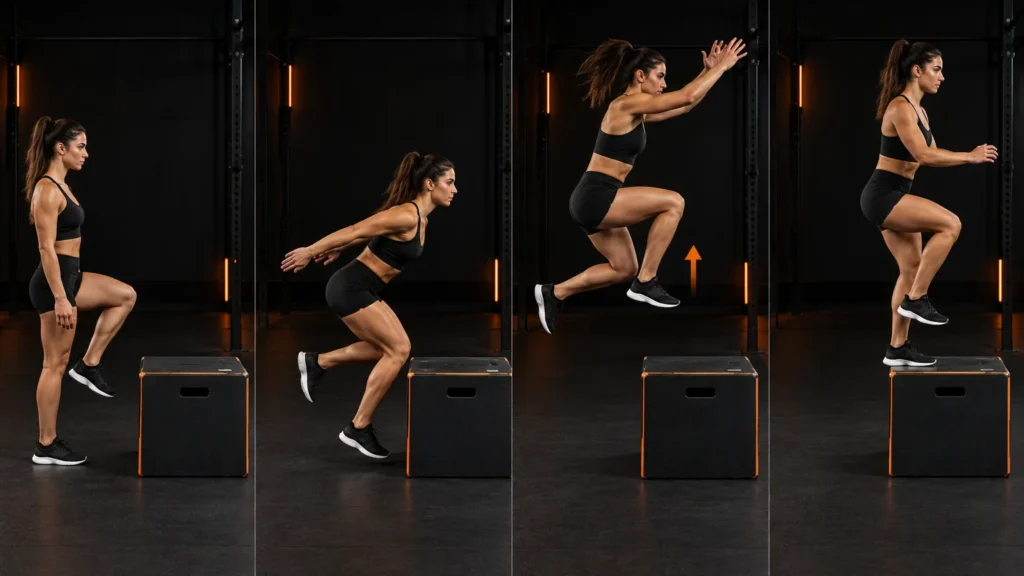
Single-Leg Box Jump

An advanced unilateral plyometric exercise designed to build explosive lower-body power, dynamic balance, and joint stability using a sturdy plyometric box.

Instructions
Exercise Technique
Common Mistakes
Variations
About This Exercise
The Single-Leg Box Jump is a demanding unilateral plyometric movement that develops explosive triple-extension power, dynamic balance, and joint robustness. By isolating one leg at a time, it addresses side-to-side strength and power imbalances that commonly arise from bilateral training. The elevated surface reduces landing impact forces compared to flat-ground jumping, making it an effective tool for athletic power development and sprint acceleration conditioning.
Tips
Notes & Safety
Master bilateral box jumps and unilateral landing mechanics before progressing to this drill. Always prioritize landing quality and control over box height. Step down onto the floor between repetitions rather than jumping backward off the box, as backward drops place unnecessary stress on the Achilles tendon and knee joints. If you experience knee or ankle instability, lower the box height immediately.
Deep Dive & Exercise Guide
Introduction
The Single-Leg Box Jump is an advanced unilateral plyometric exercise designed to build explosive lower-body force, dynamic balance, and landing stability. While traditional bilateral box jumps emphasize general vertical power, the single-leg variation challenges the athletic kinetic chain by requiring maximum effort from one limb. This makes it an invaluable movement for athletes striving to improve running speed, jumping performance, and unilateral resilience.
Benefits & Muscles Involved
This exercise primarily recruits the quadriceps and glutes to generate the explosive force required for takeoff. The hamstrings, calves (gastrocnemius and soleus), and core act as crucial secondary stabilizers, working together to maintain alignment and absorb landing shock. Key benefits include:
- Elimination of Strength Imbalances: Unilateral loading ensures that each leg produces force independently, highlighting and correcting left-to-right asymmetries.
- Joint Stability and Robustness: Demands high levels of proprioception and stabilization across the ankle, knee, and hip joints.
- Reduced Landing Impact: Landing on an elevated platform reduces the downward gravitational fall distance, diminishing impact forces on joints relative to flat-ground bounding.
How It Fits Into Training
Because of its high neuromuscular demand, the Single-Leg Box Jump should be placed early in a training session following a thorough dynamic warm-up and prior to heavy compound lifts or fatiguing metabolic conditioning. Integrating it at the beginning of a strength or power workout allows athletes to execute each jump with maximum neurological drive and pristine landing mechanics.
Who Should Use It
This movement is suited for intermediate to advanced athletes, sprinters, field-sport competitors, and track and field athletes who rely on single-leg takeoffs and directional cuts. Beginners should establish baseline unilateral strength through split squats, lunges, and bilateral box jumps before attempting single-leg jumps.
Programming Considerations
Single-leg plyometrics prioritize movement quality over volume. Athletes should target 3 to 5 sets of 3 to 5 repetitions per leg, allowing full recovery periods of 60 to 90 seconds between sets. Keep the box height modest; the primary training stimulus is rapid rate of force development and crisp landing mechanics, not reaching maximum platform height.
Tips for Better Performance
Focus on triple extension through the ankle, knee, and hip during takeoff. Use the arms aggressively to generate upward momentum. As you land on the box, aim to land softly like a spring, flexing at the hip and knee to absorb the landing silently. Always step down backward carefully between repetitions rather than jumping off the platform.
FAQs
- How high should the box be? Start with a low box, typically 12 to 18 inches, to prioritize controlled takeoffs and safe, stable landings.
- Can I land on both feet? Yes. A common regression is a single-leg takeoff followed by a two-foot landing, which reduces stabilization demands while building takeoff power.
- Why should I step down instead of jumping down? Jumping backward off the box exposes joints and the Achilles tendon to unnecessary eccentric load, increasing injury risk without training benefit.
Related Exercises: Depth Jump · Broad Jump
Conclusion
The Single-Leg Box Jump is a premier unilateral drill that bridges the gap between raw leg strength and dynamic sporting performance. When programmed with sensible volume and modest platform heights, it provides exceptional gains in explosive power, joint stability, and movement efficiency.