
B-Skip

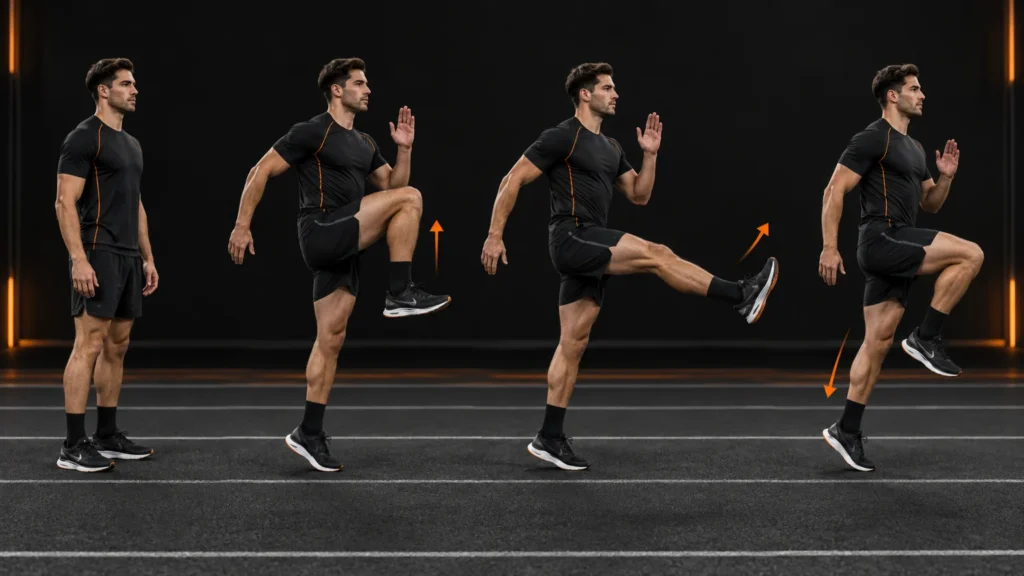
A dynamic track and field drill that develops high knee drive, active leg extension, and aggressive hamstring pull-through for efficient sprint mechanics.

Instructions
Exercise Technique
Common Mistakes
Variations
About This Exercise
The B-Skip is an essential sprinting drill pioneered in classic track and field pedagogy. Building directly on the foundation of the A-Skip, the B-Skip adds knee extension followed by a rapid, active downward and backward sweep of the lower leg. This movement pattern trains the neuromuscular system for the transition from front-side mechanics into early ground contact during top-end sprint running. When practiced regularly, it reinforces ankle stiffness, optimal foot strike beneath the hip, and rapid stretch-shortening cycle activation of the posterior chain.
Tips
Notes & Safety
Ensure a general aerobic and dynamic warm-up is conducted prior to executing dynamic skips. Athletes with acute hamstring strains, tight hip flexors, or calf tightness should reduce movement amplitude and speed until tissue tolerance is established. Avoid slapping the foot excessively hard against unyielding surfaces like concrete.
Deep Dive & Exercise Guide
Introduction
The B-Skip is an iconic sprint mechanics drill used across track and field, team sports, and endurance running. Originating from the Mach drill system developed by legendary coach Gerard Mach, the B-Skip builds upon basic knee lift by incorporating lower leg extension and a dynamic backward pull. This movement trains the body to strike the ground with authority, positioning the foot precisely underneath the center of mass to optimize forward propulsion and running economy.
Benefits & Muscles Involved
The B-Skip offers multiple technical and physical benefits for running performance. It enhances dynamic hamstring flexibility, improves neuromuscular coordination, and develops active ground strike mechanics. By demanding rapid switching between hip flexion and aggressive hip extension, it trains the stretch-shortening cycle of the posterior chain.
The primary muscles engaged include the hamstrings, glutes, and hip flexors. The hamstrings work eccentrically during leg extension and contract rapidly during the downward and backward clawing motion. Secondary movers include the calves, tibialis anterior, quadriceps, and core musculature, which provide ankle stiffness, vertical posture, and pelvis stabilization throughout each foot contact.
How It Fits Into Training
Within a balanced training regimen, the B-Skip is typically programmed as part of a dynamic track warm-up or speed technical session. It immediately follows foundational drills like ankle dribbles and A-Skips, serving as an advanced stepping stone before high-velocity build-ups, sprint repeats, or plyometrics. Incorporating the B-Skip prepares joints, tendons, and muscles for high impact loads while reinforcing correct technical movement patterns.
Who Should Use It
This drill is ideal for track and field sprinters, hurdlers, and jumpers, as well as multi-directional field sport athletes in sports like soccer, rugby, and basketball. Distance runners seeking to improve stride efficiency, eliminate overstriding, and enhance running economy can also gain substantial benefits. Because of the rhythmic coordination and hamstring mobility required, beginners should first master the A-Skip before progressing to full B-Skips.
Programming Considerations
For warm-ups and technical development, perform 2 to 3 sets over distances of 20 to 30 meters. Allow adequate recovery between repetitions so that each drill is executed with sharp coordination and high energy. Focus strictly on technical precision rather than horizontal speed; travel forward gradually while maintaining high vertical posture and crisp leg action.
Tips for Better Performance
- Maintain a tall torso with your core braced and chest upright.
- Dorsiflex the ankle fully to keep the toes pointing up toward the knee.
- Avoid kicking outward; let the leg unfurl naturally before driving it downward.
- Strike the ground with the ball of the foot directly under the hip joint.
- Use rhythmic arm action synchronized with leg turnover to maintain momentum.
FAQs
What is the main difference between an A-Skip and a B-Skip?
An A-Skip focuses primarily on vertical knee drive and immediate foot descent. The B-Skip extends the lower leg forward at the top of the knee lift and actively pulls the foot down and back in a sweeping or clawing action.
Can B-Skips cause hamstring strains?
When performed without proper warm-up or by aggressively kicking the leg straight with high force, hamstring irritation can occur. Always perform general mobility and lighter skips first, allowing the movement to feel elastic rather than forced.
Related Exercises: Hill Power March · Broad Jump · Tuck Jumps · Depth Jump · Single-Leg Box Jump
Conclusion
The B-Skip remains a gold standard athletic drill for refining maximum velocity sprint mechanics, strengthening the hamstrings, and optimizing ground reaction force. By incorporating this exercise consistently into your warm-up routine, you can build faster, more economical, and more resilient movement patterns.