
Depth Jump

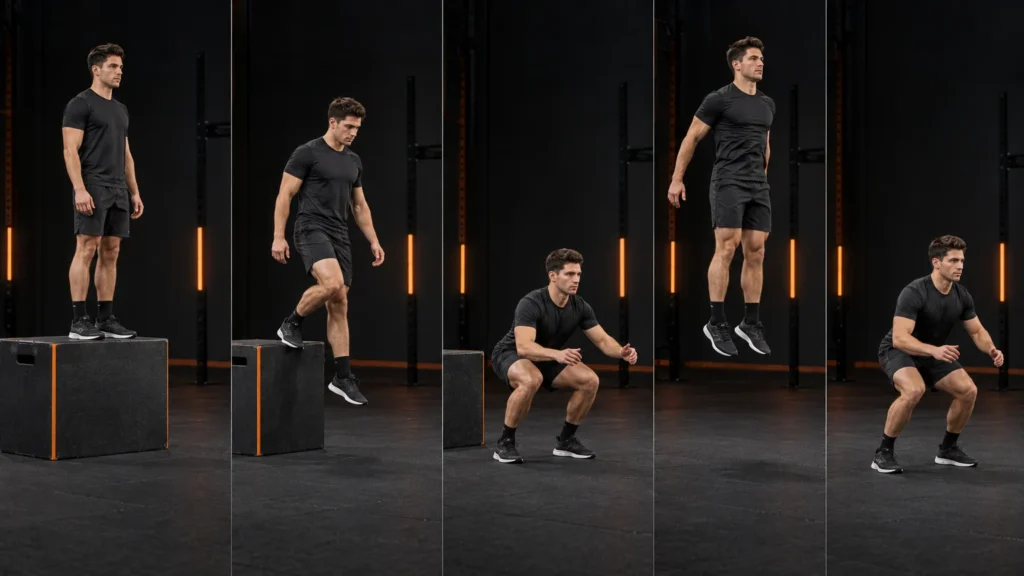
An advanced plyometric exercise designed to develop reactive strength and explosive power through rapid utilization of the stretch-shortening cycle.

Instructions
Exercise Technique
Common Mistakes
Variations
About This Exercise
The depth jump, originally popularized by Dr. Yuri Verkhoshansky as part of the Shock Method, is a cornerstone of modern athletic development. By stepping off an elevated platform, an athlete encounters an eccentric shock load upon ground impact that forces the neuromuscular system to react violently. When executed with rapid amortization, this movement recruits high-threshold motor units and maximizes the stretch-shortening cycle, directly enhancing reactive strength index (RSI) and maximum velocity capabilities.
Tips
Notes & Safety
Due to extremely high ground reaction forces (often 4 to 7 times body weight), depth jumps should only be performed by athletes with adequate strength foundations (traditionally able to squat 1.5 to 2.0 times bodyweight) and no active lower-extremity joint pain.
Deep Dive & Exercise Guide
Introduction
The depth jump is one of the most effective and intense plyometric drills available for developing explosive power. Originally known as the shock method, this exercise trains the neuromuscular system to absorb eccentric forces instantly and convert them into explosive upward propulsion. When performed correctly, the depth jump improves your ability to produce rapid force, directly translating to higher vertical jumps, faster acceleration, and greater athletic performance.
Benefits & Muscles Involved
The depth jump targets the primary extensors of the lower body while enhancing tendon stiffness and neuromuscular coordination. The quadriceps, glutes, and calf complex (gastrocnemius and soleus) act as primary movers, while the hamstrings and core provide dynamic stabilization. Key benefits include:
- Enhanced reactive strength index (RSI) and stretch-shortening cycle efficiency.
- Increased rate of force development and motor unit recruitment.
- Improved ankle, knee, and hip stiffness during rapid ground contact.
- Significant carryover to sprint acceleration and vertical jumping disciplines.
How It Fits Into Training
Because the depth jump places extreme demands on the central nervous system and connective tissues, it should be placed at the very beginning of a workout session, right after a comprehensive warm-up and prior to heavy resistance training or high-volume conditioning. This ensures maximum neural drive and eliminates fatigue-induced technical breakdown.
Who Should Use It
This exercise is designed primarily for intermediate, advanced, and elite athletes who have established a solid base of general strength and landing mechanics. Track and field sprinters, jumpers, basketball players, and volleyball players benefit immensely from its reactive demands. Beginners should first master box jumps and drop landings before progressing to full depth jumps.
Programming Considerations
Quality always takes precedence over quantity with depth jumps. A standard session typically consists of 3 to 5 sets of 3 to 5 repetitions, with box heights ranging between 30 and 60 centimeters. Allow full recovery between repetitions and sets—typically 60 to 90 seconds between sets—to keep ground contact times as brief as possible. Total weekly volume should generally not exceed 20 to 40 contacts.
Tips for Better Performance
To maximize benefits, step off the box smoothly without pushing upward. Upon landing, think of the floor as a hot surface; the objective is not to absorb deeply into a squat, but rather to reverse the downward momentum in less than 0.25 seconds. Use your arms forcefully, swinging them forward and upward at the exact moment of ground impact to assist vertical takeoff.
FAQs
What is the difference between a drop jump and a depth jump?
A drop jump emphasizes minimal ground contact time from a lower box height with minimal knee bend, while a depth jump can utilize slightly higher boxes and greater force production to achieve maximum vertical height.
How high should the box be?
For most athletes, a box height between 30 and 45 cm delivers optimal reactive power without causing excessive amortization time.
Related Exercises: Tuck Jumps · Single-Leg Box Jump · A-Skip · Hill Power March · B-Skip
Conclusion
The depth jump remains the gold standard for developing reactive power and vertical force output. When programmed strategically with appropriate recovery and meticulous attention to technique, it serves as a powerful bridge connecting absolute strength to competitive sporting speed.