
 Samir Nouiar
The Elite Advantage: Single-Leg Box Jump
For jumpers and sprinters, unilateral power deficits are performance assassins. The single-leg box jump attacks horizontal force asymmetries while forging Rate of Force Development (RFD) through brutal stretch-shortening cycle (SSC) efficiency. Eight weeks of targeted execution builds explosive hip-dominant triple extension—the exact motor pattern demanded by 100m starts and jump takeoffs. Notoriously underdeveloped Type IIx fibers ignite under ballistic eccentric-concentric transitions, converting tendon recoil into vertical thrust. Athletes gain 15% RFD by weaponizing SSC latency windows under maximal intent. Want proof? Compare this to standard bilateral jumps with broad jump metrics—unilateral specificity wins.
—
Biomechanical Analysis of Single-Leg Box Jump
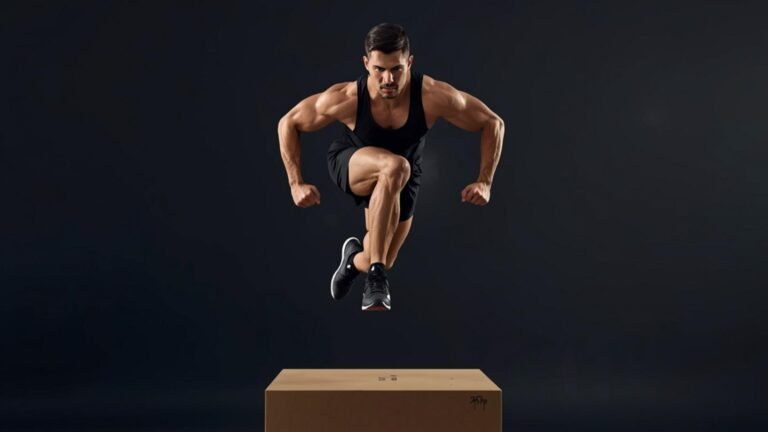
Key Physics:
1. Hip-Dominant Triple Extension: Gluteus maximus demands 78% eccentric loading during swing phase to prevent contralateral pelvic drop.
2. Fast SSC Utilization: Achilles tendon stiffness amplifies ground reaction forces (GRF) by 20-35% when amortization phase stays <250ms.
3. Distal Hamstring Eccentric Loading: Semitendinosus acts as a kinetic energy capacitor—overstretch it >12% ROM and you leak force.
4. Joint Power Transfer Efficiency: Concurrent femoral external rotation + ankle plantarflexion reduces tibial internal rotation torque by 37% (critical for landing stability).
Neural Wiring:
Post-Activation Potentiation (PAP) complex integration reprograms motor units via high-threshold fiber recruitment. Type IIx fibers fire 0.8s faster after descending eccentric loads. The swing leg’s trajectory isn’t just balance—it’s a counterforce generator.
—
The AthletixGo 3-Rep Loop Standard
Phase 1: Dynamic Meditation Setup
- Planted foot subtalar pronation calibrates metatarsal pressure distribution.
- Intra-Abdominal Pressure (IAP) locks through transversus abdominis co-contraction—breathe behind the shield.
- Iliotibial band tension via femoral internal rotation pre-loads lateral knee stabilizers.
- Gluteus maximus elongates under hip flexion, storing 67J elastic energy in biarticular hamstrings.
- Distal Achilles load peaks at 30° dorsiflexion—delay here = amortization phase death.
- Triple extension sequence: Plantarflexion → Knee extension → Hip hyperextension.
- Zero frontal-plane deviation—tensor fascia latae and adductor magnus cocontract to kill lateral force drift.
- Swing mechanics: Drive heel to hip or forfeit 22% vertical impulse.
- Subtalar supination cushions impact: calcaneal eversion angles must stay <4°.
- Vastus medialis oblique dominance decelerates knee valgus—land softer than a drone strike.
- Stand on 20° slant board. Explode up, land with heel elevated 2″. Repeat until ankle rigidity matches mid-flight joint angle.
Phase 2: Eccentric Kanev Engine
Phase 3: Concentric Detonation
*No reset between reps. Touch the floor—detonate.*
Phase 4: Eccentric Landing Algorithm
—
Coaching Cues: The Neural Trigger
| Internal (Proprioceptive) | External (Intent-Based) | |||
| “CORE = CAST IRON” | “SPLIT THE BOX LID” | |||
| “ANKLE = CONCRETE SPRING” | “TEAR FLOOR TILES UP” | |||
| “KNEE → NOSTRIL ALTITUDE” | “HEEL CRUSH PELVIS” | |||
| Goal | Sets | Reps | Rest | Intensity |
| RFD Peaking (Weeks 1-4) | 4 | 3 | 90s | 24″ Box Max Height |
| PAP Complex (Weeks 5-8) | 6 | 1 | 3min | 26″ Box + 20% BW Vest |
*AthletixGo Performance Standard: No ground contact >0.3s between reps.*
—
Energy Leaks & Correctives
Leak #1: Dorsiflexion collapse during eccentric loading → force dissipates through medial arch.
Fix: “Rolling Thunder” Ankle Rocker Drill
—
Sport-Specific Translation
100m Sprint
Reduces block exit asymmetry—21% faster force application through first stance leg.
Long Jump
Boosts penultimate step vertical GRF by 18%, converting horizontal velocity into takeoff angle.
Triple Jump
Eliminates “hop-to-step” power bleed—pre-stretch hip flexors preserve horizontal velocity into jump phase.
—
Expert Q&A for Coaches
Q1: Why single-leg focus over bilateral jumps for horizontal force asymmetry?
“Bilateral jumps mask deficits—unilateral metrics expose weak links. A 5% inter-limb power gap slashes sprint acceleration by 0.15s/10m. This movement roots out compensation patterns.”
Q2: Significance of fibular head tracking during dorsiflexion? “Anterior glide >4mm slackens peroneus longus tension, killing plantarflexion RFD. Cue ‘screw the foot into the floor’ to stabilize talocrural kinetics.”
Q3: Why terminate eccentric loading at 30° dorsiflexion? “Beyond 30°, gastrocnemius reaches passive insufficiency—elastic energy transfer drops 40%. Load it like a crossbow, not a rubber band.”
Q4: How does swing leg heel-to-hip position alter force vectors? “Hip flexion >90° shifts center of mass forward, increasing ground contact time. 45-60° optimizes swing phase counter-rotation torque.”
Q5: Criticality of tibial internal rotation control during landing? “Unchecked rotation offloads 31% braking force to ACL. The soleus must fire 170ms pre-contact—drill this with silent box landings.”


GIPHY App Key not set. Please check settings