
Single-Leg Box Jump

A unilateral plyometric exercise designed to build explosive lower-body power, dynamic stability, and triple extension on a single leg.
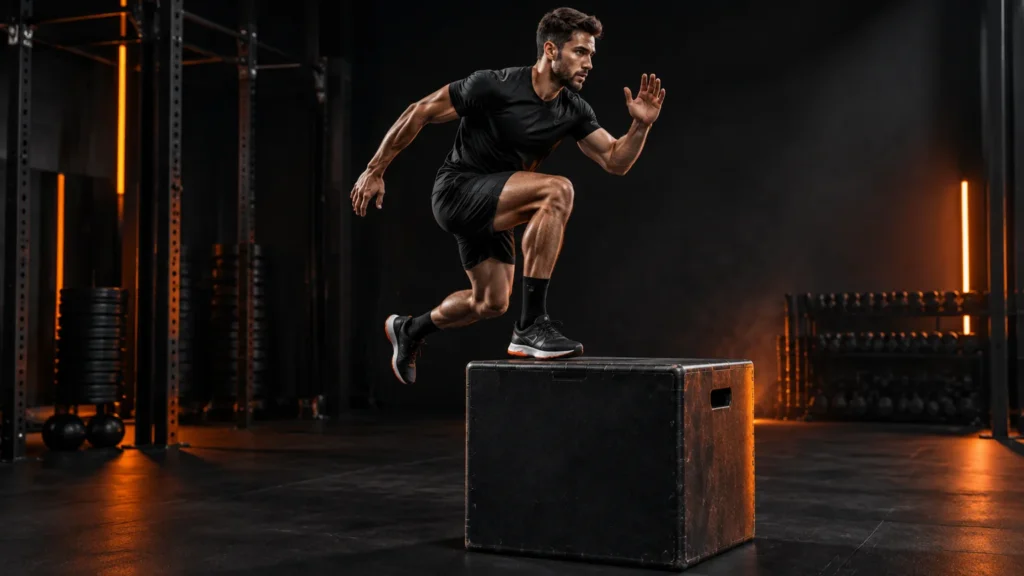
Instructions
Common Mistakes
Variations
About This Exercise
The Single-Leg Box Jump is an advanced unilateral plyometric drill that demands high levels of explosive power, balance, and proprioception. Because sports and sprint activities take place primarily on one leg at a time, training unilateral power transfer directly enhances sprint acceleration, change-of-direction ability, and vertical jump height while reducing bilateral strength imbalances.
Tips
Focus on triple extension through the ankle, knee, and hip. Land quietly like a cat, keeping your knee aligned directly over your middle toes without collapsing inward.
Notes & Safety
Master bilateral box jumps and unilateral landing drills (such as single-leg snap downs) before attempting this movement. Always step down from the box rather than jumping down backwards to avoid Achilles tendon stress and knee trauma.
Deep Dive & Exercise Guide
Introduction
The single-leg box jump is a premier unilateral plyometric exercise engineered to build explosive vertical power, unilateral balance, and dynamic landing stability. While bilateral jumps develop absolute force output, unilateral jump variations directly replicate the single-leg propulsion patterns seen in sprinting, cutting, and jumping sports. By jumping onto an elevated surface, athletes achieve maximum concentric power output while minimizing the high eccentric impact forces associated with landing back on the floor.
Benefits & Muscles Involved
This explosive exercise primarily targets the glutes and quadriceps to produce forceful hip and knee extension. Concurrently, the hamstrings and calves (specifically the gastrocnemius and soleus) contribute to the terminal ankle drive and assist in stabilizing the joint upon landing. The core musculature, including the rectus abdominis and obliques, works continuously to maintain an upright, balanced trunk throughout the flight phase.
- Develops unilateral rate of force development and explosive triple extension.
- Reduces bilateral strength and power deficits between limbs.
- Teaches safe deceleration and dynamic single-leg landing mechanics.
- Spares joint stress by landing at an elevated height rather than full ground level.
How It Fits Into Training
The single-leg box jump should be placed early in a workout session, immediately following a comprehensive dynamic warm-up and prior to heavy compound lifting or fatiguing conditioning work. Because the central nervous system must be completely fresh to maximize recruitment of fast-twitch muscle fibers and maintain pristine movement mechanics, fatigue should not precede this exercise.
Who Should Use It
This movement is designed for intermediate to advanced athletes, sprinters, team-sport competitors (such as basketball, soccer, and football players), and track and field athletes seeking to optimize single-leg power. Beginners should first establish adequate single-leg strength and master bilateral box jumps alongside single-leg balance and stick drills before progressing to single-leg vertical jumps.
Programming Considerations
Because the objective of the single-leg box jump is maximum velocity and movement quality, volume should remain low to moderate. Prescribe 3 to 5 sets of 3 to 5 explosive repetitions per leg. Allow complete rest periods of 90 to 120 seconds between sets to ensure neuromuscular recovery. Box height should challenge power production without forcing the athlete to tuck their knee excessively or compromise safe landing alignment.
Tips for Better Performance
Focus on a sharp, coordinated arm swing to amplify vertical ground reaction forces. Initiate the movement with an active hip hinge, drive through the whole foot, and ensure the knee tracks over the second toe throughout takeoff and landing. Always step down off the box onto a firm surface or lower step rather than jumping backward off the platform.
FAQs
How high should the box be?
Start with a conservative box height between 12 and 18 inches. The goal is explosive vertical propulsion and clean landing mechanics, not flexing the hip merely to clear a tall box.
Can I land on two legs?
Yes. Taking off on one leg and landing on two feet is an excellent regressive step that develops single-leg propulsion while distributing landing forces across both limbs.
Conclusion
The single-leg box jump is an essential tool for unlocking elite single-leg power and stability. By training explosive extension and disciplined deceleration on each leg independently, athletes can eliminate strength imbalances, elevate field performance, and fortify lower-body durability.