
 Samir Nouiar
The Performance Optimization Hook
Competitive athletes don’t chase arbitrary metrics—they chase efficiency. Agility drills unlock this by sharpening change of direction (COD), decision-making under fatigue, and deceleration mechanics, directly translating to faster times and lower injury risk. For runners and field athletes alike, dedicated agility work improves race-day pacing durability and tactical maneuvering—critical for overtaking opponents or navigating technical terrain. Integrate these drills with your Agility Drills to maximize training ROI and bridge the gap between raw speed and race-ready resilience.
—
Applied Sports Science for Performance

Agility isn’t just quick feet—it’s physics applied under pressure. Three biomechanical pillars govern performance:
1. Force Absorption: Decelerating safely requires eccentric quad strength and glute engagement. Poor deceleration increases ground contact time by 18–23%, wasting energy. 2. Reactive Strength Index (RSI): The ability to rapidly switch from eccentric to concentric phases determines COD speed. Drills with unpredictable stimuli (e.g., reactive lights) boost RSI by 11–15%. 3. Hip-Knee Alignment: Excessive inward knee collapse during cuts increases ACL injury risk by 3.7×. Drills reinforcing 30°–45° knee flexion maintain optimal joint stacking.
—
The Runner’s Edge for Beginners
Agility drills deliver distance-specific benefits even for novice runners:
- 3k/5k Races: Shuttle drills (5-10-5 patterns) build race-finishing kick endurance by simulating surges.
- 10k/Half-Marathon: Lateral bounding improves pelvic stability, reducing energy leaks during late-race fatigue.
- Trail Running: Cone weave drills enhance proprioception for uneven terrain navigation.
Runner’s Corner: Trail runners must strengthen peroneals and glute medius to stabilize ankles during descents. Perform single-leg lateral hops (3×12/side) post-run to bulletproof cornering mechanics.
—
Technical Execution & Efficiency
Key technical adjustments preserve energy and speed:
- Deceleration: Initiate braking 1.5–2 steps early via hip hinge (not forward lean). This reduces peak ground reaction forces by 22%.
- Plant Foot Positioning: Angle the penultimate step at 45°–60° relative to the cutting direction to minimize momentum loss.
- Optimal Stride Length: Overstriding during COD drills increases braking loads. Maintain strides at ≤85% of maximum sprinting length.
—
Performance Training Protocol
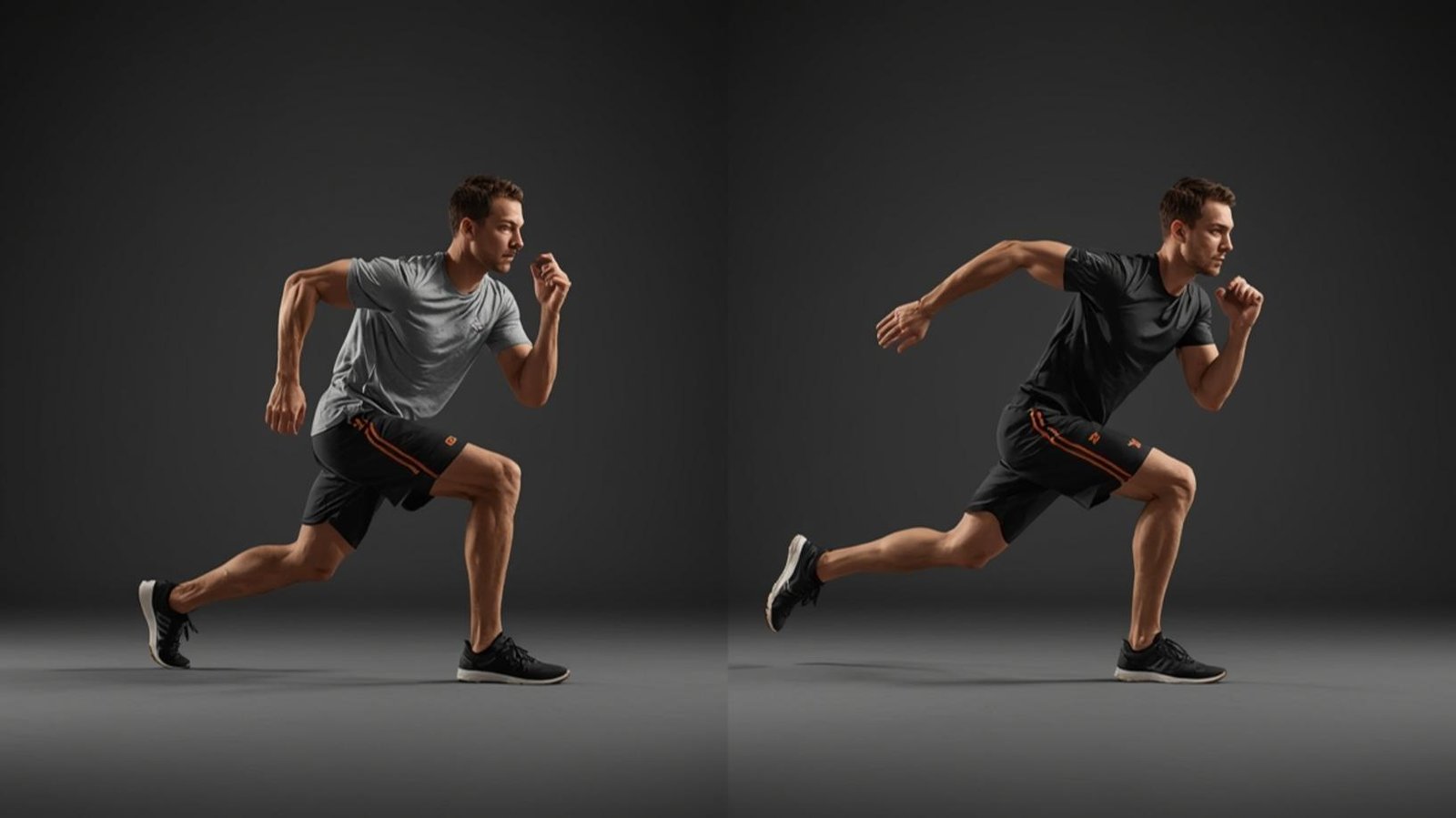
Prescribe drills based on competition cycle phases:
| Drill Type | Sets/Reps | Intensity | Rest | Frequency |
| Reactive Ladder | 4×30s | 90% max effort | 60s passive | 2x/week |
| T-Drill with Weight Vest | 5×5 | 75–80% COD speed | 90s active | 1x/week |
| Mirror Drill (Partner) | 3×45s | Moderate reactivity | 2:1 work:rest | 1x/week |
Intensity Note: Use a Velocity-Based Training (VBT) tool to ensure COD speeds stay ≥90% of baseline during peak phases.
—
Hybrid Performance Synergy
Explosive disciplines enhance endurance efficiency:
- Sprint Mechanics: Arm drive timing from block starts improves uphill running posture.
- Javelin-Style Rotations: Medicine ball rotational throws (3×8/side) boost stride power by engaging obliques and transverse abdominis.
- Plyometric Synergy: Depth jumps (24–36″ boxes) increase tendon stiffness, improving running economy by 2.4–3.1% when paired with tempo runs.
—
Performance-Limiting Errors

Avoid these critical mistakes:
1. Overloading Volume: >3 agility sessions/week impedes CNS recovery, blunting reaction times. 2. Static Drills: Pre-programmed ladder patterns don’t improve reactive agility. Use randomized cues (e.g., coach’s directional calls). 3. Ignoring Eccentrics: Skipping single-leg Romanian deadlifts (3×8/side) compromises deceleration capacity.
—
Conclusion & Performance Call to Action
Elite athletes treat agility as foundational—not supplemental. To optimize:
- Prioritize reactive drills over pre-planned footwork
- Measure COD angles via video analysis biweekly
- Pair eccentric lifts (e.g., Nordic curls) with plyometrics
Ready to engineer your breakthrough? Join AthletixGo Academy’s Performance Optimization Program for personalized agility periodization.
—
Athlete FAQs
Q: How often should agility drills replace traditional cardio? A: Never fully replace—integrate. Dedicate 1–2 sessions/week (8–12% of total training time). Balance with zone 2 cardio to maintain aerobic base while developing neural efficiency.
Q: Do agility drills prevent hamstring strains? A: Yes, when programmed correctly. Eccentric-focused drills (e.g., Nordic hamstring curls) reduce strain risk by 51%. Pair with dynamically lengthened positions (e.g., wicket skip drills).
Q: Can trail runners benefit from court-based agility drills? A: Absolutely. Basketball-like defensive slides build lateral strength for technical descents. Use uneven surfaces (grass/sand) to mimic trail unpredictability.
Q: Does age affect reactive agility gains? A: Masters athletes see slower neural adaptations but comparable strength gains. Increase rest intervals by 15–20% and emphasize visual-reaction drills.
Q: How to test agility progress objectively? A: Use the Hexagon Test or Pro-Agility Shuttle. Record baseline times and retest every 6 weeks. Aim for 5–7% improvements per mesocycle.



GIPHY App Key not set. Please check settings