
 Samir Nouiar
Explosive Acceleration: The Competitive Athlete’s Speed Catalyst
## The Performance Optimization Hook Why do elite athletes prioritize the first 5-10 meters of a sprint? Because explosive acceleration dictates race outcomes, breakaways, and injury resilience. For competitive runners, shaving 0.1 seconds off your initial surge can mean overtaking rivals or hitting PRs. Explosive acceleration isn’t just raw power—it’s the synergy of efficient force application, neuromuscular timing, and biomechanical precision. Miss this foundation, and you sacrifice consistency under fatigue—or worse, invite undue injury risk.
## Applied Sports Science for Performance 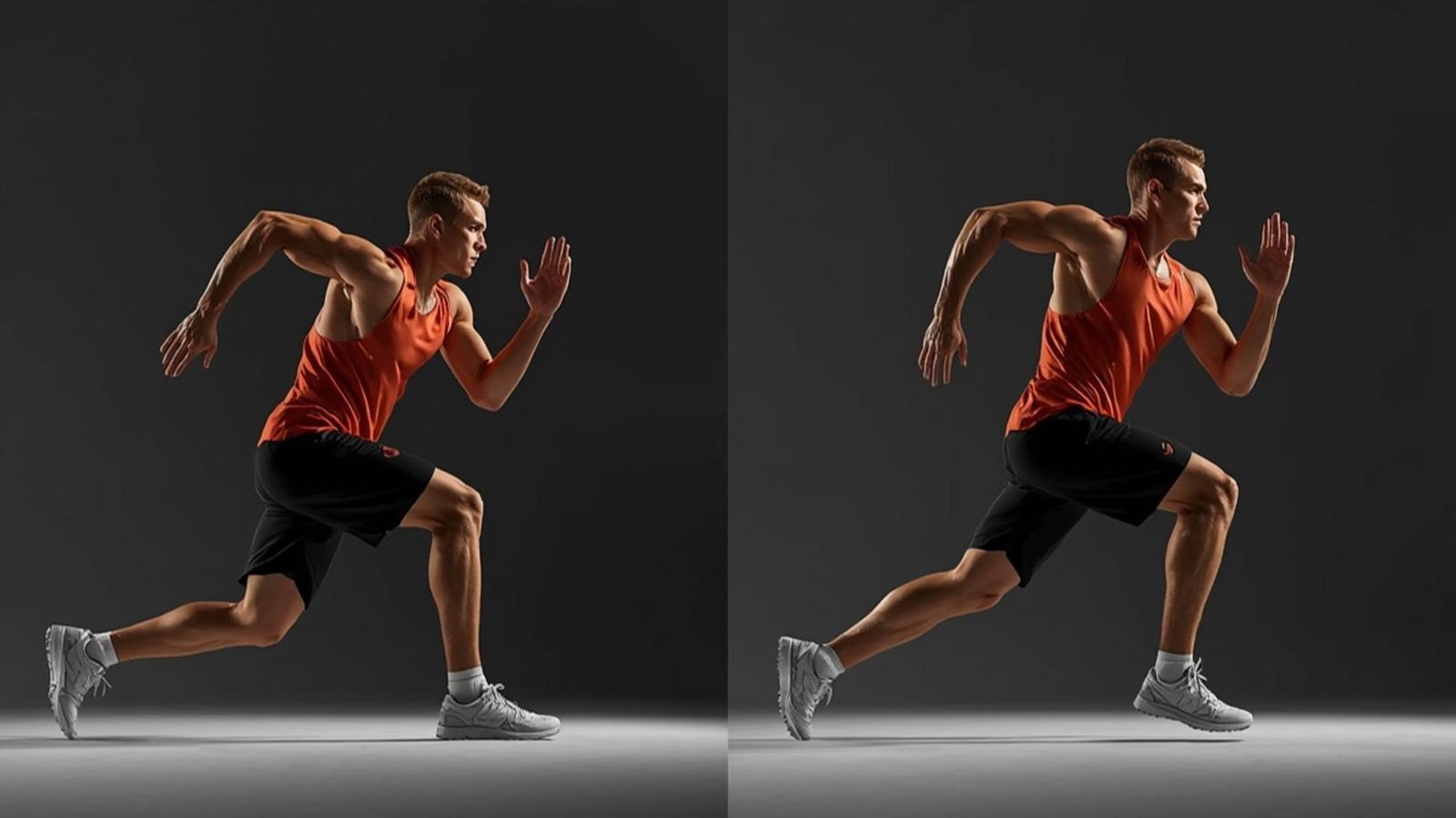 Your body’s acceleration capability hinges on three physiological pillars:
- Fast-Twitch Fiber Recruitment: Sprinting demands type IIb fibers generate forces 3-5× faster than slow-twitch fibers.
- Triple Extension Mechanics: Optimal hip, knee, and ankle extension during ground contact (≤0.18 seconds) impacts propulsive force.
- Stiffness Modulation: Tendon elasticity (Achilles, patellar) stores/releases energy at 90-95% efficiency versus muscular effort alone.
- Protocol: 6-8×20s all-out sprints (1:4 work:rest ratio)
- Purpose: Elevate vVO₂ max (velocity at VO₂ max) by 4-7% in 6 weeks.
- Improves running economy (↓ 7% O₂ cost at threshold pace).
- Teaches rapid motor unit cycling (↑ stride cadence at race pace).
- Enhances tendon recoil—less muscular effort per km.
- Rearfoot touchdown visible on screen
- Arm crossing torso midline
- >30ms delay between rear foot liftoff and front foot strike
- Skipping A’s (dynamic Achilles loading)
- Lateral lunge walks (hip mobility)
- 3×50m buildups (neuromuscular priming)
Practical translation? Acceleration efficiency improves via horizontal force emphasis (≥20% of total output) and minimizing vertical oscillation. Track metrics like ground contact time asymmetry using wearable tech—variations >5% indicate imbalance risks.
## The Runner’s Edge for Beginners 3K Specialists: Accelerations train lactate buffering—critical for 800-1500m surges. 5K Athletes: Boost closing speed in final 400m; 2-3-second differentials decide podium places. 10K Competitors: Strengthen resilience against pace drops after kilometer 8.
Runner’s Corner: Sprint Interval Training (SIT)
### Technical Execution & Efficiency 1. Posture: 45° forward lean (nose over toes) reduces braking forces. 2. Arm Action: 90° elbow drive synchronized with stride frequency prevents rotational energy leaks. 3. Foot Strike: Midfoot contact beneath hips ensures reactive stiffness—not heel striking’s decelerative effect.
## Performance Training Protocol  Acceleration Development Grid
| Exercise | Sets/Reps | Intensity | Rest | Weekly Frequency |
| Sled Drags | 4×20m | 20% BW load | 90s | 2x |
| Broad Jumps | 3×5 | Max-effort | 2min | 2x |
| Flying 10s | 6×10m build-up | 95% speed | 3min | 1x |
*Progression: Add 5% resistance weekly or reduce rest by 10s every 3 sessions.*
## Hybrid Performance Synergy Speed isn’t siloed. Javelin throwers’ bounding drills enhance running triple extension. Similarly, embedding sprint mechanics into endurance training:
## Performance-Limiting Errors  Critical Mistakes 1. Overstriding (foot landing ahead of COM) ↑ braking forces by 18% and ACL/shear injury risk. 2. Insufficient Eccentric Loading: Skipping Nordic curls or depth jumps compromises hamstring force absorption (↑ strain susceptibility). 3. Excessive Volume: >3 acceleration days/week depresses fast-twitch fiber % via chronic fatigue.
## Conclusion & Performance Call to Action Mastering explosive acceleration demands precise biomechanics, progressive overload, and recovery discipline. Prioritize horizontal force, short ground contacts, and neural recovery. Ready to transform starts, surges, and finishes? Join AthletixGo Academy’s Performance Tier—where 74% of athletes hit acceleration PRs in 8 weeks via custom biomechanical profiling.
## Athlete FAQs 1. How often should I train acceleration without overtraining? Peak frequency is 2-3 sessions weekly, separated by 48h. Use HRV monitoring—readings <7% baseline indicate incomplete recovery. Pair heavy acceleration days with tempo runs <75% intensity.
2. Which acceleration drill offers the highest ROI for endurance athletes? Resisted sprints (sleds/parachutes). They target horizontal force vectors specific to race starts and hill surges, elevating stride power by 12-15% in controlled studies.
3. Can explosive training negatively impact my aerobic capacity? No—when periodized properly. Block periodization (e.g., 4-week acceleration focus + 2-week VO₂ max block) enhances both systems. Avoid concurrent endurance/acceleration sessions within 8h.
4. How do I know if my mechanics limit acceleration? Film sagittal-plane footage. Key red flags:
5. What’s the optimal warm-up for acceleration sessions? 10min progressive drill sequence:



GIPHY App Key not set. Please check settings